“Meet people where they already are, not where they were previously.” This single line carries more weight in marketing than most playbooks combined. No matter the industry, the offer, or the price point. Communication only works when the channel matches the way people actually live their day.
And well, the home services and real estate industries are slowly figuring it out, by bringing SMS into the conversation, making sure homeowners aren’t ignoring outreach and leads aren’t dying inside an inbox or a voicemail. But sending texts is just half the work done, what about the rest of the picture?
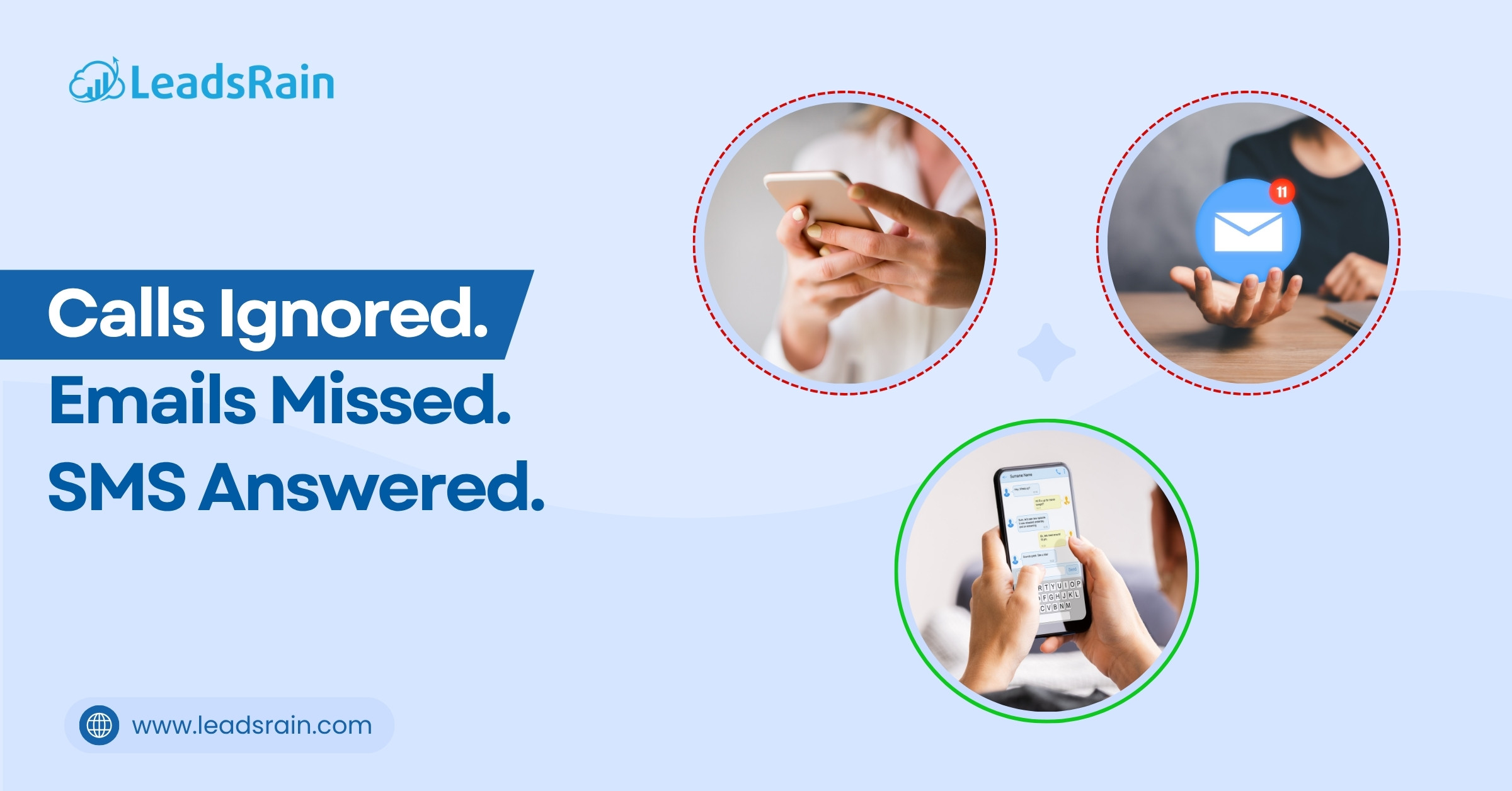
How do you decode why SMS pulls a response when calls and emails are disappearing like anything is the real question. Here’s where most outreach teams hit the wall. The number gets dialed, the email gets blasted, the team assumes the lead just isn’t interested. That’s a half lie to believe in, of course some leads aren’t interested, but in reality, the channel itself was wrong from the start. The homeowner saw the call and let it ring. The email landed in a folder they open once a week. Your message just got dwelled in the pool of other unwanted and spam folders in their device.
In this article we’d be talking about why homeowners respond faster to SMS than calls or emails, and what that means for anyone trying to reach them.
Why the Channel Matters More Than the Message?
Every outreach campaign is connected with a very basic assumption that’s designed to work across the broadest possible range of audiences. It really sounds reasonable until you realize a homeowner’s day is specific and not broad only.
A homeowner has a job, has to commute, handle family, run errands, and the most intriguing yet tiring part is, a phone that buzzes maybe two hundred times a day. The chance where they can stop everything to answer just an unknown call is of very small possibility. The window where they sit down to read a marketing email is even smaller. But the opportunity where they glance at a text message and tap a reply is open all day long, between meetings, in line at the store, at the kitchen counter while dinner cooks.
The three variables that matters the most when talking about what most outreach teams misses are channel preference, response speed, and trust signals. Because they were never really measured anywhere. The script just got handed down where the last campaign left off and started running. The exact same offer can run through two different channels and give entirely different results. The variance always comes down to whether someone is actively matching the channel to the audience or running on autopilot mode.
There is a version of homeowner outreach that just simply pushes messages out. And there is a version that lands in front of a homeowner at the exact second they have a free hand to respond. What amazes everyone is that both versions are chasing the same lead. The only thing that is differentiating them is the channel that carries the message.
The Reasons Homeowners Actually Pick SMS
Before jumping into tactics directly, you should know which behavioral layers are working underneath and what each one actually does to the response rate.
- Open rate is the foundation of everything else. SMS open rates sit near the high nineties while marketing emails struggle to clear a quarter of that, and unknown calls get picked up at a rate that keeps shrinking every year.
- Response window is the speed signal. Most text replies come back within the first few minutes of delivery, while email replies stretch into hours or days, and missed calls often never get returned at all.
- Friction is the silent killer of every channel except SMS. A call demands the homeowner stop their day and talk. An email demands they sit down, read, think, type, and send. A text demands a thumb tap and seven words.
- Spam filtering is where most marketing emails unnoticeably get buried or lost, particularly on inboxes already overloaded with promotions and newsletters where a brief pause before opening most of the time means the message never gets seen at all.
- Caller ID skepticism is the data feed that homeowners depend on primarily for trust; without a recognizable name the call gets sent to voicemail and the system can’t really predict when, or if, the homeowner will ever listen.
- Visual preview ensures the right message gets the right attention, which is not bound just to convenience but is also a direct multiplier on conversion rates. A text shows the first line on the lock screen. An email shows a sender and a subject the homeowner has been trained to ignore.
2026 Response Benchmarks Across Channels
The gap between an SMS-led outreach and a call or email approach is not just theoretical, it shows up in the numbers every single week.
- Campaigns that lead with SMS reportedly had a higher reply-to-send ratio when compared to outreach still running on email-first sequences.
- Homeowner segments contacted by text reported quicker first-response times from the moment the message lands. Email and voicemail follow-ups perform at a level on which the cadence cannot smooth out on its own.
- Outreach lists with verified mobile numbers show profoundly stronger engagement scores because the channel has a complete data set to work from rather than a fractional one distorted by landlines and outdated emails.
- Texts with a clear, single question significantly outperform the ones without them on response precision, the difference between a message that anticipates a quick yes-or-no and one that waits for the homeowner to compose a paragraph.
- Local-area-code SMS sends see measurable response increases in the same-day window without the corresponding opt-out spikes when the rest of the messaging is relevant.
- Well-timed text message campaigns manage to lower the no-response rate well below the email and call baseline, treating anything above a certain unanswered threshold as a signal that something upstream needs immediate attention rather than a number to live with.
How to Use SMS to Reach Homeowners Step by Step?
Step 1: First and Foremost Pull the Baseline Data Before Starting
Changing channels without baseline data is just like switching recipes you have never tasted. Having no reference point for improvement or what made things worse. A full month of outreach reports gives you a reliable picture of what normally looks like for your specific homeowner audience. Now that picture gets measured at every subsequent shift in approach.
- Export reply rates per channel across the last thirty calling and emailing days.
- Calculate response rate as a percentage of delivered messages and not total contacts.
- Break the response window down by hour to identify when homeowners are actually replying.
- Flag each and every outreach attempt running without a clear single ask.
Step 2: Clean and Structure Your Contact List
If you have a stale, bloated, or a bad contact list your outreach is running on, no channel switch can save it. The response data you collect only learns from what it sees and if what it is seeing is not actual representative of how your audience behaves at its best, the patterns you build from it will not be either.
- Don’t burden the list, size it to match actual follow-up capacity.
- Mix up the segments by separating verified mobile numbers from landlines and unverified contacts.
- Remove all the unqualified leads, outdated numbers, and stale email addresses.
- Create and separate high-intent homeowner segments for the channels that match their behavior.
Step 3: Confirm Compliance and Opt-In Status
The legal framework around SMS is built on consent, below a certain threshold of documented opt-in, that outreach becomes unreliable and the audience is simply not authorized to receive marketing texts. Running below that threshold does not only invite penalties, but also breaks the whole idea of how trust-based messaging is supposed to work.
Actions to take:
- Confirm each contact has a sufficient and documented consent record.
- Audit list sources and consolidate verified opt-ins where possible.
- Enable clear opt-out language across every send.
- Set up persistent record-keeping on compatible platforms to close the compliance gap.
Step 4: Tune the Send Time, Cadence, and Message Length
These three elements work together and pulling one without watching the others will either drift the campaign toward opt-out spikes or will end up capping the response rate without realizing it. Start conservative, before evaluating, give each change a full week of sends, and never let the opt-out rate climb past the threshold the platform considers healthy.
Here’s how:
- Set an initial send window aligned with when homeowners are typically free.
- Adjust cadence in small increments and observe for seven days before moving again.
- If the audience handles short bursts better than paragraphs, trim the message length to a single ask.
- Reduce send frequency only if reply rates are still dropping after timing adjustments.
Step 5: Speed Up the Reply Loop and Match Tone to Your Audience
Where conversations die before they even start is the gap between a homeowner replying and a human getting back to them. When people text and hear nothing, they assume it as automated, and disengage. Tighten that window and your replies will actually turn into conversations.
By doing this:
- To reduce reply lag, route inbound texts to a live person during business hours.
- Resolve the tone or template issues coming through in the first response.
- Shift heavy outreach or high-intent contacts into your peak response windows.
- Ease cadence during low-response periods based on hourly reply-rate data.
Common Mistakes That Kill Homeowner Response Rates
Most outreach response issues are not just channel problems but are habit problems. The same mistakes keep showing up across all campaigns and the frustrating part is that none of them are complicated enough to fix.
- Running outreach with very few documented opt-ins and wondering why the audience is going silent.
- Loading unsorted or oversized contact lists and letting the team work from data that nowhere represents your actual audience.
- Skipping the single-ask format in messages and unknowingly switching the conversation into a slower mode without even realizing it.
- Changing multiple variables at once and having no idea which adjustment actually made a change.
- Leaving long-form copy in SMS sends and losing replies to messages that read like emails.
- Treating the initial channel setup as it is and then never revisiting it as the audience evolves.
- Ignoring the opt-out rate until it becomes a compliance issue instead of managing it as a performance signal from day one.
Putting It All Together
An SMS strategy that is properly built does not just sends, it compounds. Every list you clean, every send window you tune, every reply loop you tighten feeds into a system that gets sharper with every campaign. The results do not just start showing up in a mere night, they show up consistently, week after week, season after season.
The teams that are getting the most homeowner replies are not doing anything special. They are just paying attention to the right channel at the right time and adjusting as the data needs is the simple rule they follow. What creates the actual difference is better understanding of the economical behavior, consistency, research, and updated data and the outreach effort that pushes messages and one that drives appointments, offers, and closed deals..
Your homeowner audience is already willing to respond. Only the channel is the part that unlocks it.
Ready to reach more homeowners through the channel they actually answer? The shift from call-and-email to SMS-first is not a leap, it is a sequence of small, measured changes that any team can run with the right plan.