
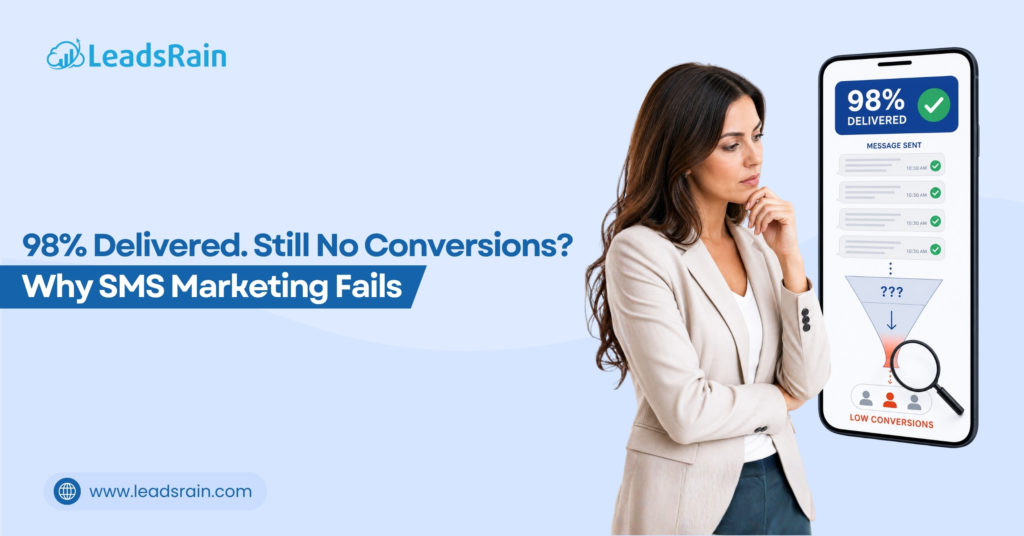
Businesses celebrate ninety eight percent delivery rates while reply rates plummet, opt outs climb, and cost per booked appointment rises unnoticed. Carrier routing success does not equal revenue generation, and high volume sends to unqualified or fatigued audiences waste budget while silently damaging sender reputation.
The engagement gap proves that delivery only confirms inbox placement, not customer intent or willingness to act. When campaigns optimize for send volume instead of two way response velocity, marketing teams scale activity that generates data but not actual bookings or conversions.
This article uncovers the hidden failure points behind strong delivery metrics, outlines a diagnostic framework to identify engagement breakdowns before they impact revenue, and provides optimization tactics that turn delivered messages into confirmed appointments and measurable ROI.
Why High Delivery Rates Mask Campaign Failure?
Delivery metrics confirm carrier routing success but reveal nothing about message relevance, timing alignment, or customer willingness to engage with the content. A text can reach a mobile device perfectly while being instantly ignored, deleted, or marked as spam because it arrived at the wrong moment, targeted the wrong segment, or offered zero contextual value.
Businesses tracking delivery instead of reply velocity, booking conversion, or cost per acquired job optimize for the wrong outcome. Scaling campaigns based on inbox placement alone leads to inflated lead counts, increased follow up labor, and higher true acquisition costs. The metric that matters is not whether the message arrived, but whether it triggered a measurable business action.
Carrier algorithms prioritize sender reputation over raw volume, so high delivery today does not guarantee inbox placement tomorrow if engagement signals deteriorate. Rising spam complaints, declining reply rates, and frequent opt outs trigger silent filtering that reduces future deliverability, making yesterday’s ninety eight percent success rate tomorrow’s bottleneck.
7 Hidden Failure Points Behind Strong Delivery Metrics
Strong delivery reports often hide structural issues that drain campaign ROI. When messages reach devices but fail to generate replies or bookings, the breakdown typically traces to audience targeting, timing, or message architecture rather than carrier performance.
- Reply rate below twenty percent signals content fatigue or timing mismatch even when delivery exceeds ninety five percent, indicating messages arrive but lack compelling relevance or clear next steps
- Opt out spikes above point five percent per campaign indicate message irrelevance or frequency overload that damages long term database health and accelerates subscriber churn
- Click through rate decline while open rate stays stable reveals passive scanning without intent to act, requiring offer restructuring, copy refresh, or stronger urgency triggers
- Delivery to non serviceable zip codes wastes spend on contacts you cannot actually serve, inflating lead volume without booking potential and skewing campaign ROI calculations
- Missing preference routing forces one size fits all frequency that ignores customer choice and accelerates fatigue accumulation across segments that expected different contact cadence
- After hours sends generate three times more spam complaints, triggering carrier filtering that silently reduces future deliverability and damages sender trust scores
- Attribution gaps between SMS platform and CRM hide which messages actually drove revenue, perpetuating investment in low conversion sequences because delivery volume replaces booking data as the success metric
How To Fix SMS Campaigns That Deliver But Do Not Convert?
Resolving engagement breakdowns requires shifting from volume based execution to precision targeting, compliance aligned timing, and closed loop attribution. Implement these optimization steps to restore reply velocity and align SMS spend with actual revenue outcomes.
- Shift primary KPI from delivery rate to reply velocity and booking conversion to align optimization with revenue outcomes instead of carrier routing metrics
- Implement zip code validation at opt in to filter non serviceable contacts before they consume budget or dispatcher time
- Add preference centers that let subscribers select message frequency and service categories to reduce fatigue and hard opt outs
- Configure timezone aware quiet hour enforcement to prevent after hours sends that trigger spam complaints and carrier throttling
- Integrate SMS platform with CRM via webhook to preserve end to end attribution and measure true cost per booked appointment
- Audit carrier feedback reports weekly to catch spam complaint trends before deliverability drops impact entire sender ID
Metrics That Actually Predict SMS Campaign Success
Delivery confirms routing, but engagement metrics reveal whether your campaign drives revenue or just consumes budget. Track these indicators to evaluate true SMS performance and adjust targeting before opt outs or filtering degrade results.
- Reply rate above thirty percent indicates content relevance and timing alignment that drives two way engagement and moves prospects toward conversion
- Booking conversion rate of fifteen percent or higher confirms messages move customers from awareness to scheduled appointment without manual follow up
- Cost per booked job under fifty dollars validates efficient spend allocation compared to alternative acquisition channels like paid search or direct mail
- Opt out rate below point two percent per campaign signals healthy frequency and content relevance that preserves database value long term
- Delivery failure rate under one percent confirms carrier trust and sender reputation that sustains long term inbox placement across all networks
- Reply velocity under sixty seconds for urgent service categories captures peak intent before competitors respond and secures high value appointments
Quick Diagnostic Checklist
- Compare delivery rate against reply rate weekly to identify engagement gaps masked by high inbox placement
- Audit opt out spikes immediately after campaign sends to isolate problematic copy, timing, or audience segments
- Validate zip codes at point of capture to prevent spend leakage on contacts outside service territory
- Configure preference routing to let subscribers control message frequency and reduce hard opt out accumulation
- Enforce quiet hour compliance across all time zones to protect sender reputation and prevent carrier filtering
- Sync SMS platform with CRM via webhooks to track booking attribution and calculate true cost per acquired job
- Monitor carrier feedback reports for spam complaint trends and pause underperforming sequences before deliverability degrades
Putting it to the end
SMS marketing fails when businesses optimize for delivery vanity metrics instead of engagement and conversion signals that drive actual revenue. High inbox placement means nothing if messages arrive to unqualified audiences, wrong time zones, or fatigued subscribers.
Treat SMS as a precision channel where relevance, timing, and compliance determine long term success. Shift tracking to reply velocity, booking conversion, and cost per job to build campaigns that convert instead of just deliver. Ready to audit your SMS performance and replace delivery tracking with revenue focused metrics? Contact support@leadsrain.com for campaign optimization that measures success by booked appointments.