
Mobile messaging has split into two distinct ecosystems. Push notifications offer zero per-message delivery to engaged app users, while SMS guarantees near-universal reach outside any platform dependency. The real challenge isn’t picking the higher-performing channel in isolation, but aligning infrastructure, audience behavior, and compliance requirements with your business model.
Businesses that treat these channels as interchangeable end up with fragmented attribution, notification fatigue, and wasted spend. Push excels at driving in-app actions and retention for existing users, but it collapses the moment app adoption drops or OS permissions tighten. SMS delivers immediate visibility to any mobile device, yet requires explicit consent and carrier-compliant routing to maintain deliverability at scale.
This article breaks down the technical architecture behind each channel, compares engagement mechanics across industries, maps optimal use cases, and provides a prioritization framework that prevents overlap while maximizing conversion velocity.
Infrastructure, Ownership, and Control: How Each Channel Operates
Push notifications rely on operating system gatekeepers and app installation. Apple’s APNs and Google’s FCM route messages only to devices with the app installed, notification permissions enabled, and active network connectivity. Delivery is free, but reach is entirely dependent on user behavior and platform policy shifts. When users disable alerts or uninstall the app, the channel goes dark without warning.
SMS routes through telecom infrastructure independent of apps or OS ecosystems. Every message travels via carrier networks to any active mobile number, provided explicit TCPA consent exists. While this introduces per-message costs and compliance overhead, it guarantees predictable reach, full list ownership, and direct CRM integration. Subscriber data remains portable, auditable, and immune to third-party platform changes.
Control and attribution differ fundamentally. Push analytics live within platform silos, often lacking cross-channel visibility or standardized consent documentation. SMS operates on carrier-verified delivery receipts, two-way reply tracking, and documented opt-in timestamps. Businesses that prioritize SMS gain complete ownership of their contact database, while push-dependent strategies remain vulnerable to OS updates, permission fatigue, and app store policy enforcement.
Use Case Mapping: Where Each Channel Wins
Prioritization depends on where your customers actually complete actions and how urgently they need information.
- Appointment confirmations, weather alerts, and OTP verification route to SMS for guaranteed delivery and instant visibility without app dependency.
- In-app feature adoption, loyalty program updates, and content recommendations perform better via push, where contextual UI elements and deep links drive seamless engagement.
- Abandoned cart recovery uses push for existing app users with high session frequency, while SMS captures broader audiences who browsed via mobile web or guest checkout.
- Field service dispatch, emergency repairs, and healthcare reminders require SMS to reach technicians, patients, or homeowners who may not maintain branded apps.
- Media streaming, gaming, and SaaS platforms leverage push for session reactivation, achievement alerts, and subscription renewal prompts tied directly to product usage.
Why SMS Delivers Superior Business ROI Compared to Push Notifications?
SMS outperforms push notifications as a primary business communication channel because it eliminates platform dependency and guarantees universal reach. While push notifications trap businesses inside walled gardens controlled by operating system updates and app store policies, SMS operates on open telecom networks that reach every active mobile device. This fundamental difference makes SMS the more reliable and profitable option for driving measurable business outcomes.

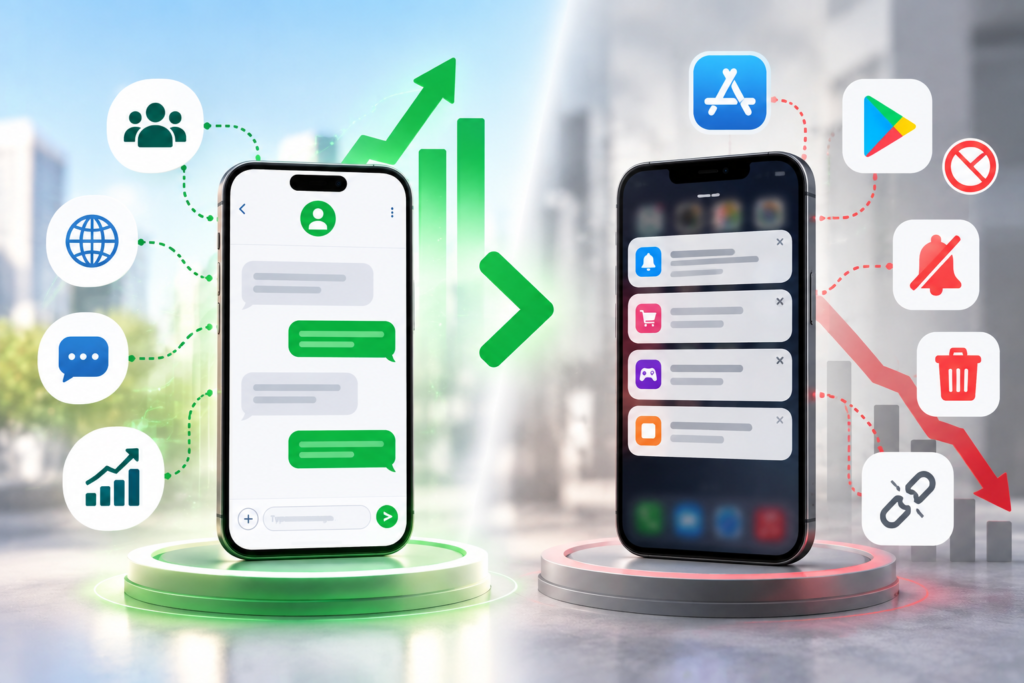
Complete Data Ownership and Portability
Businesses own their SMS contact lists outright, allowing seamless migration between platforms without losing subscriber history or consent records. Push audiences remain locked inside specific apps and vanish the moment a user deletes the application or changes devices.
Universal Reach Without App Friction
SMS requires zero downloads or permission toggles beyond initial opt in. This captures the entire mobile audience, including high intent prospects who refuse to install branded apps for a single transaction or service inquiry.
Direct Two Way Conversion Mechanics
SMS enables immediate back and forth dialogue that qualifies leads, answers questions, and books appointments within the same thread. Push notifications only drive users to open an app, adding friction that drops conversion rates for complex or urgent transactions.
Predictable Attribution and Revenue Tracking
Dedicated tracking numbers and CRM webhooks tie every SMS reply directly to booked revenue. Push analytics often fragment across siloed dashboards, making it difficult to calculate true cost per acquisition or lifetime customer value.
Engagement Mechanics and Performance Benchmarks
Delivery and open rates tell only part of the story. The value of each channel depends on intent capture, response depth, and actionability.
- SMS achieves 95 to 98 percent delivery to valid mobile numbers and 90 to 98 percent open rates within three minutes. Two way reply capability drives direct booking, qualification, and commerce without app friction.
- Push notifications show 20 to 45 percent open rates on average, heavily dependent on app category, user tenure, and operating system permission status. Engagement typically requires app launch, making conversion slower for off platform actions.
- SMS reply velocity averages under 90 seconds for urgent or transactional prompts, enabling real time routing to live agents or booking engines.
- Push click through rates peak during in session activity or feature onboarding but drop significantly for cold re engagement, where app open probability falls below 15 percent.
How to Prioritize Without Fragmenting Customer Experience
Deploying both channels without coordination creates duplicate messaging, attribution gaps, and accelerated opt outs. A structured prioritization framework prevents overlap while maximizing conversion velocity.
- Audit app adoption rates and active user retention before investing heavily in push. If less than 30 percent of your audience maintains your app, SMS becomes the primary outreach channel.
- Route by intent urgency. Time sensitive, transactional, or compliance critical messages deploy via SMS. Retention, feature education, and in app engagement route to push.
- Implement a unified preference center that lets subscribers choose channel frequency, message categories, and quiet hour alignment across both platforms.
- Sync push and SMS platforms with your CRM using webhooks to maintain single customer view, prevent duplicate sends, and track revenue attribution across channels.
- Phase rollout by launching the highest impact channel first, establishing baseline deliverability and reply metrics, then layering the secondary channel only after opt out rates stabilize below 0.2 percent.
Quick Prioritization Checklist
- Choose SMS if your audience lacks consistent app adoption or requires immediate, off platform action
- Choose push if your product relies on in app engagement, feature onboarding, or session reactivation
- Run both only with strict use case segregation, unified CRM sync, and automated overlap suppression
- Prioritize compliance documentation over volume scaling to maintain carrier trust and operating system permission stability
- Measure success by cost per booked action and reply velocity, not raw delivery counts or notification impressions
Summing it up
SMS and push notifications solve different problems. Push drives retention and in app engagement for established users, while SMS service guarantees reach, compliance ready attribution, and immediate action for audiences that live outside app ecosystems. Prioritization depends on where your customers actually complete transactions, how urgently they need information, and which infrastructure aligns with your compliance capacity.
Businesses that isolate use cases, prevent channel overlap, and track revenue attribution instead of delivery volume scale predictable growth without fragmenting customer experience. Ready to architect a notification strategy that prioritizes reach, compliance, and booking velocity? – Contact support@leadsrain.com for channel integration, compliance setup, and CRM sync that turns messaging into measurable revenue.